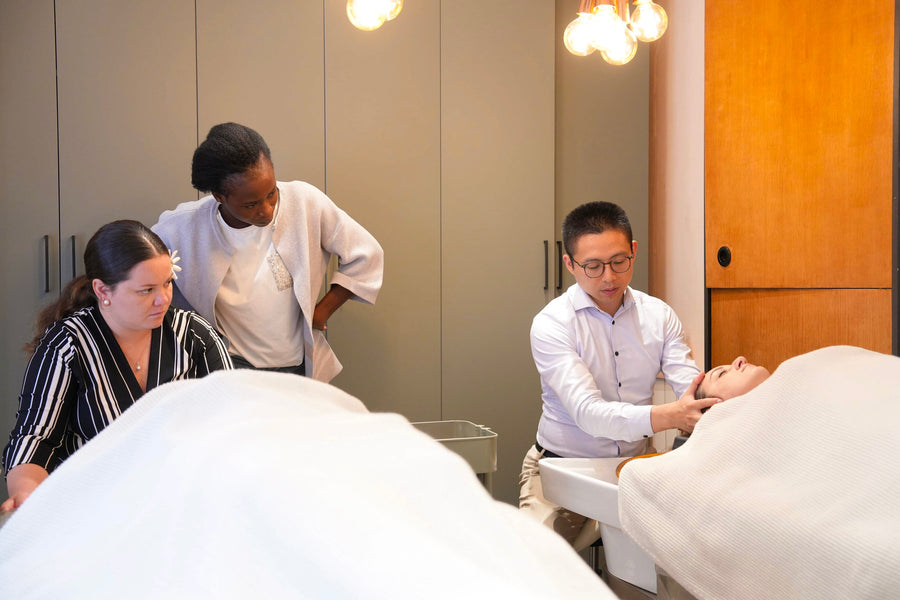
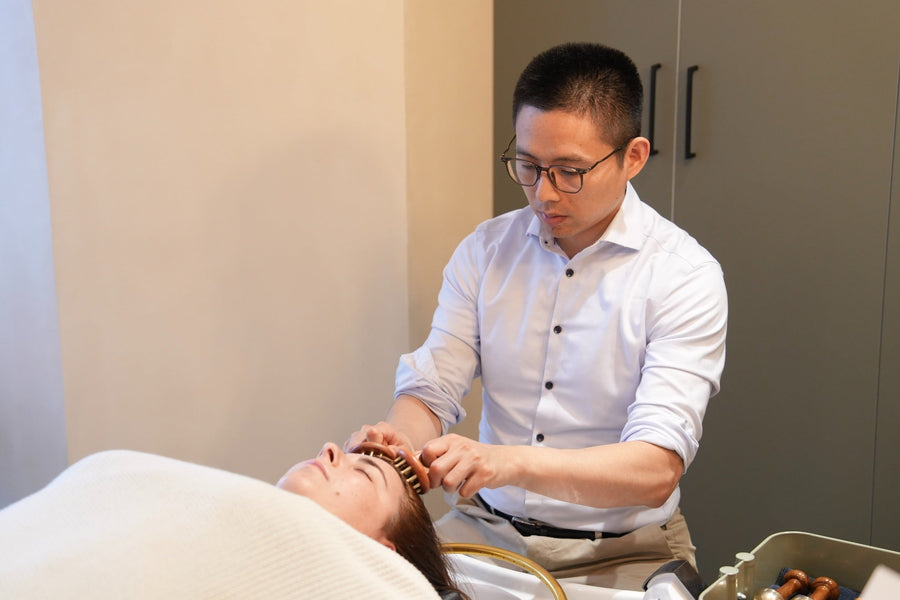
This topic opens the “Trichology and hair care” module of the Head Spa Training at the Pro Headspa Academy (registered training organisation no. 11 75 71242 75 in France), which has trained more than 600 professionals. Jak Zheng, founder of Pro Headspa, teaches it from twelve years of practice in hairdressing and head spa, and from training received in France, Japan and China. His stance: in a head spa, products matter as much for the result as for the sensory experience.
Which products are really used in a head spa?
The hair care market offers hundreds of products, but they fall into three groups. Cleansers prepare the scalp and the fibre: the scrub and the shampoo. Nourishing products treat and protect: conditioner, mask, leave-in care, serum and massage oil. Fixing products, finally, serve the hairstyle. Knowing the role of each family avoids the most common mistake: asking a product to do something it cannot do.
Massage oil deserves particular attention, because it is what the client feels under your hands for many minutes. It must glide without feeling greasy and remain discreet. Jak Zheng uses jojoba oil: light, low in scent, stable over time and close to certain components of sebum, it suits most scalps.
| Family | Main role in a head spa |
|---|---|
| Scrub | Exfoliate the surface of the scalp and remove excess sebum and residue |
| Shampoo | Cleanse the scalp and the fibre |
| Conditioner | Smooth the hair surface and make detangling easier |
| Mask | Nourish and strengthen the fibre more deeply |
| Leave-in care and serum | Protect, hydrate and enhance after the treatment |
| Massage oil | Provide glide and comfort during the massage |

Why can the shampoo make a head spa fail?
The primary role of a shampoo is to cleanse: removing excess sebum, dead cells, styling product residue, pollution and sweat. Its limits are just as important to know. A shampoo does not repair split ends, does not replace a deep treatment because its contact time is too short, does not make hair grow and does not change its nature.
The ingredient list helps, without telling everything. A strong cleansing agent is not a flaw in itself: it appears in many premium formulas, and what matters is its concentration and the balance of the formula. Conversely, a cleansing agent reputed to be mild guarantees nothing: Jak Zheng recalls developing dandruff within a month with a shampoo presented as organic and mild. As for short-chain parabens, they remain authorised by European regulations; avoiding them mainly meets the expectations of clients sensitive to “clean” messaging.
In practice, a head spa seeks lightness. Shampoos for normal or fine hair, and those formulated for all scalp types, suit most clients and limit the number of products. Very rich shampoos for damaged hair or smoothing shampoos weigh down the roots, the opposite of the airy feeling you are looking for. Finally, anti-yellow shampoos have no place in a relaxing treatment: their pigments can stain the basin.
Which scrub should you choose for your workstation?
The scrub gently exfoliates the scalp and prepares the rest of the treatment. Three formats exist. Plant powders, such as clay or rhassoul, take a long time to apply and rinse, and Jak Zheng advises against them, notably because they are not compatible with head spa basins with a tank. Enzymatic scrubs exfoliate without friction, which suits sensitive scalps, but they spread poorly and are expensive per treatment. “Two-in-one” scrubs, which combine exfoliation with mild cleansing agents, spread easily and rinse quickly: this is the format recommended in the training.
Your workstation is therefore part of the choice. On a plumbed-in bed, water never runs out. On a basin with a tank, every litre counts and the circuit must stay clean: a product that rinses quickly and leaves no deposit directly serves your organisation.
 Headspa Bed Ultra
 Reva Headspa
Conditioner or mask: what is the difference?
Both nourish and enhance, but not at the same level. Conditioner is a light formula that works on the surface: it smooths the cuticles opened by washing, retains moisture, makes detangling easier and limits breakage. It suits fine or short, slightly dry hair. The mask, richer and more concentrated, works more deeply on the fibre. It is intended for long, dry or weakened hair.
Two families of masks cover most needs. The repairing mask, rich in proteins or amino acids, strengthens hair weakened by colouring, bleaching or heat. The moisturising mask, based on humectants, restores suppleness to hair that is dry by nature or dried out by the environment. In both cases, one rule prevails in a head spa: the mask goes on the lengths, never on the roots, to keep the scalp light.
A mask does not durably transform hair in a single session. That is why recommending a home routine is part of the treatment: retail is not just extra revenue, it is the logical continuation of the follow-up, as we explain in our guide to building head spa client loyalty.

How does the diagnosis guide the choice of products?
Everything is decided before the first gesture. The same client may have an oily scalp and dry lengths: these two findings do not call for the same product. The shampoo is chosen first for the scalp, the treatment for the fibre. A very nourishing shampoo on normal hair leaves it heavy and sticky by the end of the wash. How this conversation unfolds is detailed in our article on the three stages of a head spa diagnosis.
A diagnostic camera makes this choice visible: the client sees for herself on screen what justifies the proposed shampoo and treatment.

How do you select a professional brand?
The first criterion is effectiveness observed in the treatment room: test products on yourself, then on several hair types, before committing. Next come a gentle fragrance, an image consistent with a wellbeing message, and genuine support. Calculate the real cost per treatment and read contracts carefully: oversized starter packs, minimum volumes or exclusivity clauses weigh heavily on a small business. The recommended balance remains two or three complementary brands that you know perfectly.
How can you learn more about choosing products?
Product families, reading ingredient lists, diagnosis and the place of each treatment in the sequence are part of the online Head Spa Training designed by Jak Zheng, alongside acupressure, massage and complete protocols filmed on a bed and on a basin. To practise in the treatment room under a trainer’s eye, the in-person Head Spa Training also gives access to the online training area.
 Online Head Spa Training
 In-person Head Spa Training
Frequently asked questions
Do you need a special head spa shampoo?
No. Above all, you need a light shampoo that rinses easily and suits the client’s scalp. A formula for all scalp types covers most needs and limits the number of products to manage.
Can essential oils be used during a head spa?
For atmosphere, yes, through brief inhalation or light diffusion, away from the face, as in Japanese salons. Application to the scalp is not advisable without serious aromatherapy training: these highly concentrated substances can irritate or make the skin sensitive to the sun.
How many products do you need to get started?
Few. A scrub, one or two shampoos, a conditioner, a repairing mask, a moisturising mask and a massage oil are enough for most treatments.
The right product starts with the right diagnosis.
Learn to read the scalp and choose each treatment with the Pro Headspa Academy method, online or in person.