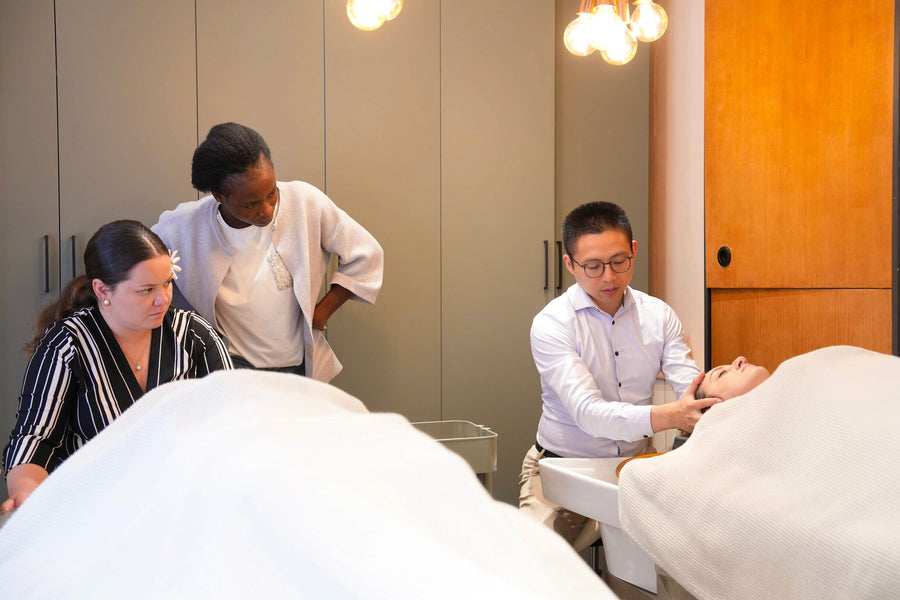
At Pro Headspa, we often see practitioners put a great deal of energy into filling their diary, only to start all over again the following month. The problem is rarely visibility: it almost always lies in what happens between the first and the second session. This is one of the guiding threads of the Pro Headspa Academy (French training organisation no. 11 75 71242 75), which has trained more than 600 professionals: a lasting business rests on expertise, visibility and profitability, and the first pillar shapes the other two.
Why does loyalty matter more than attracting new clients?
A loyal client comes back without you having to convince her again. She knows your treatment room, trusts your choice of treatments and talks about you to those around her. A new client, by contrast, has to be found, reassured and then won over: every first visit costs communication time, sometimes advertising budget, and a degree of uncertainty. A diary that relies solely on acquisition remains fragile.
Jak Zheng repeats it in the Academy’s Business and Marketing course: the best marketing in the world will never replace an excellent service. Instagram, TikTok or a well-kept Google profile bring a client to your door; what she experiences in the following hour decides whether she will return. Loyalty therefore starts at the welcome, in the quality of your listening and in the consistency between what you show on social media and what the client actually feels.
A business that works solves a real problem. Understanding what your clients are looking for, deep relaxation, an uncomfortable scalp, a need to switch off from stress, lets you offer follow-up that makes sense to them. Our article on finding your head spa niche explores this positioning in detail.

Why is the consultation your first loyalty tool?
The consultation is not just a technical step. It is the moment the client understands that you are taking care of her, not of an anonymous scalp. By listening to her request, observing, then explaining the treatment you propose, you turn a standard service into personalised care. We describe this method in our article on the three stages of a head spa consultation.
The consultation has a second, often underestimated virtue: it creates a starting point. If you note what you observed and what the client wanted, you can show her at the next session how things are evolving. A client who sees follow-up comes back for that follow-up, not only for the relaxation. This is where a diagnostic camera changes the relationship: with LinaVision, the client sees her own scalp on screen, and the CRM built into the software centralises your clients, their analyses and their history. Advice becomes a shared observation that can be compared from one visit to the next.
Stay within your role, however. Head spa is a wellbeing and scalp hygiene treatment, not a medical treatment. Sudden hair loss, patches or intense itching call for a doctor or dermatologist: referring the client is part of being a professional, and it strengthens her trust.
Why offer a treatment course rather than a single session?
A single session is an experience; a series of sessions is a follow-up. The difference is not only commercial. Many of the benefits sought in head spa are built through regularity: the habit of relaxing, maintaining a balanced scalp, the ability to let go more quickly from one session to the next. Offering a course tells the client that you have a goal for her, and a path to reach it.
The Academy’s Sauna Dome Ultra course illustrates this principle well. During the first sessions, the body discovers the warmth of infrared and sweating often remains modest; it develops gradually over the following sessions. Selling a single session means taking the risk that the client leaves before she has truly felt what the device brings.
How you present the course matters as much as its content. The training recommends selling a transformation rather than a number of sessions: a name that tells the client’s goal speaks more than a quantity. The most natural moment to discuss it is at the end of the treatment, when the client has just felt the effects of the session and the goals raised in the consultation are still fresh. Formats and pricing are then worked on in training, according to your clientele and your area.
 LinaVisionThe scalp on screen and a CRM to follow each client.View product →
 Sauna Dome UltraA service that naturally builds into a course.View product →
 Headspa Bed UltraA silent treatment, and the only plumbed-in bed compatible with the dome.View product →
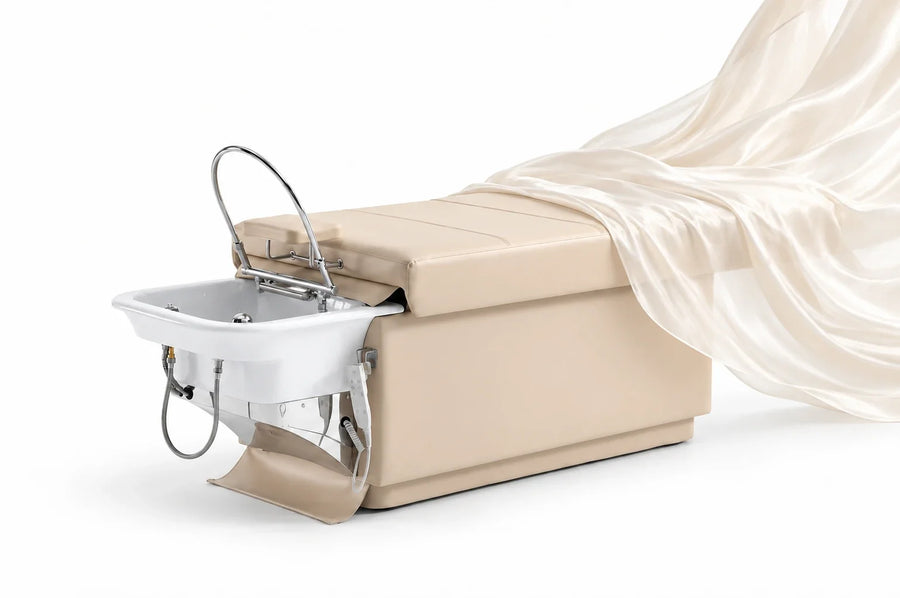
Equipment supports this dynamic without replacing it. On the Headspa Bed Ultra, the arch works without a motor and the basin is ceramic: no pump noise, no splashing water, two details the client does not name but does feel. It is also the only plumbed-in bed on the market compatible with the Sauna Dome Ultra, which combines warmth with the water treatment.
What should you do after the session to make clients want to return?
The end of the session is a strategic moment, and often the most neglected. A client helped up too quickly, while you are already checking the diary, leaves with a production-line impression. By contrast, a gradual return to calm, a glass of water, a few tips for the hours ahead and a reminder of the goals raised in the consultation extend the experience beyond the treatment room. It is in this relaxed moment that suggesting the next appointment feels most natural: setting the date before she leaves stops the good intention from fading into everyday life.
The next day, a short message to ask how she is often makes the difference. It is not about pushing a sale, but about showing that the relationship continues. The gesture takes a few seconds, and few practitioners do it.
Finally, a satisfied client becomes your best ambassador. Gift cards, which the Academy ranks among the profitability levers alongside treatment courses and add-on sales, let her offer the experience she loved. Google reviews left after a great session play the same role, as we explain in our article on a head spa’s Google profile.
| Stage of the journey | What builds loyalty | What loses the client |
|---|---|---|
| Welcome and consultation | Real listening and an explained treatment | The same service for everyone |
| During the treatment | A calm rhythm, a silent station | Adjustments and noise mid-session |
| End of the session | A return to calm and the next appointment booked | A rushed departure with nothing proposed |
| After the visit | A message the next day, visible follow-up | No news until the next promotion |
| Over time | Promises kept and measured | Exaggerated results that disappoint |

Frequently asked questions
Should you offer a treatment course from the first session?
Yes, as long as it follows from the consultation. A course proposed at the end of the first session, linked to the goal the client expressed, feels logical. A course unrelated to what she said feels like a forced sale.
Is software essential to follow your clients?
No, but it makes everything easier. What matters is keeping a record of what you observed and what the client wanted. The LinaVision CRM, combined with scalp images, makes this follow-up visible from one session to the next.
How can you learn to build your services and pricing?
The Pro Headspa Academy’s online Head Spa training, designed by Jak Zheng, covers consultation, complete filmed protocols and building your pricing. To practise in the treatment room with a trainer, the in-person Head Spa training also gives access to the online area.
A loyal client is built session after session.
Expertise, follow-up and honesty: master the foundations of a service that makes clients want to return with the Pro Headspa Academy.